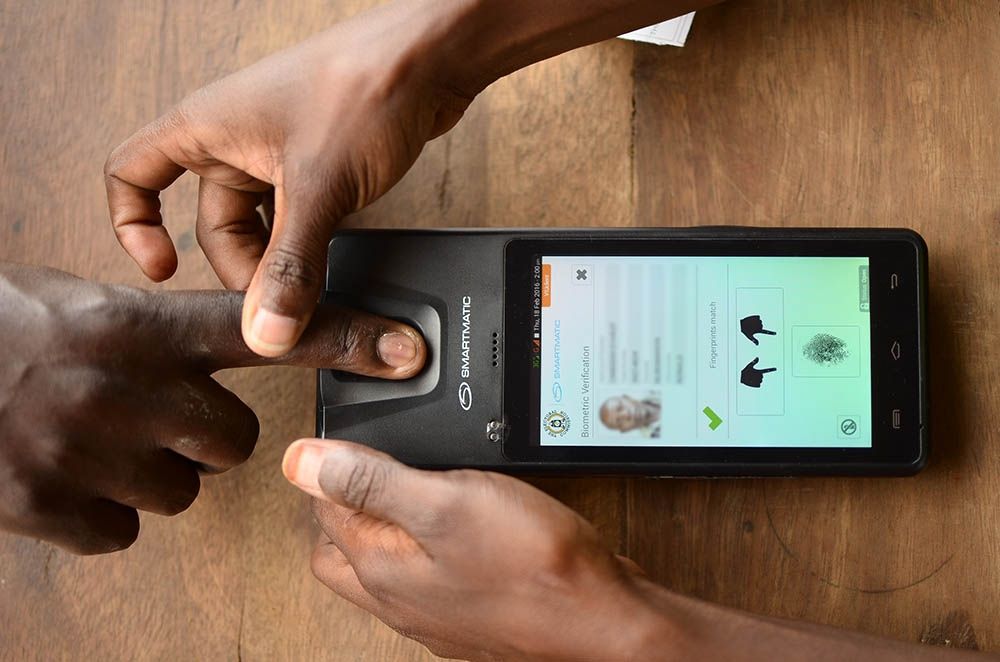
A coalition of political parties and civil society organizations has filed a legal challenge against the Electoral Commission’s (EC) planned deployment of Biometric Voter Verification Kits (BVVKs) in the January 15 general elections, arguing that the enabling regulation is unlawful and risks undermining the credibility of the electoral process.
The objection, filed by Mbaabaali Jude & Co. Advocates on behalf of registered political parties, presidential candidates, and civil society organizations, seeks the immediate suspension of Statutory Instrument (SI) No. 98 of 2025.
The regulation formally titled The Electoral Commission (Adoption and Manner of Use of Biometric Voter Verification System) Regulations, 2025 was issued on December 24, 2025, by the Minister of Justice and Constitutional Affairs, Norbert Mao.
It mandates the use of BVVKs at all polling stations to electronically identify voters.
Petitioners argue that the SI is ultra vires the Electoral Commission Act (Cap 176), procedurally flawed, and retroactive, warning that its implementation could trigger “a significant legal and operational crisis” during the elections.
Uganda has in recent years increasingly adopted electoral technology to improve transparency and curb voter fraud.
In late 2025, the EC procured 109,142 BVVKs for voter verification, rejecting proposals to reuse Uganda Bureau of Statistics (UBOS) biometric kits from the 2024 national census.
The Commission conducted demonstrations for Members of Parliament and the media, assuring stakeholders of the kits’ accuracy and reliability.
However, opposition leaders, including Leader of the Opposition Joel Ssenyonyi (Nakawa West) and former Leader of the Opposition Mathias Mpuuga (Nyendo-Mukungwe Division), have questioned both the legal basis and operational readiness of the technology.
They contend that the regulation should have been tabled before Parliament in accordance with the Statutory Instruments Act, warning that unilateral deployment undermines constitutional safeguards.
The petition cites inconsistencies with Sections 12(2), (4), and (5) of the Electoral Commission Act, which empower the EC in areas such as voter statistics, ballot management, and penalties, but do not explicitly authorize the mandatory use of BVVKs.
It also references High Court Miscellaneous Application No. 11 of 2020, in which similar regulations issued under the Local Government Act were nullified for exceeding statutory authority.
The Center for Constitutional Governance represented by Dr. Sarah Bireete, currently under detention has publicly endorsed the challenge, emphasizing the need to uphold legality and constitutionalism in the electoral process.
With the January 15 elections drawing closer, analysts say a court ruling or parliamentary clarification will be crucial to safeguarding the credibility and transparency of the polls. Uganda currently has more than 21.6 million registered voters across 50,739 polling stations nationwide.
END