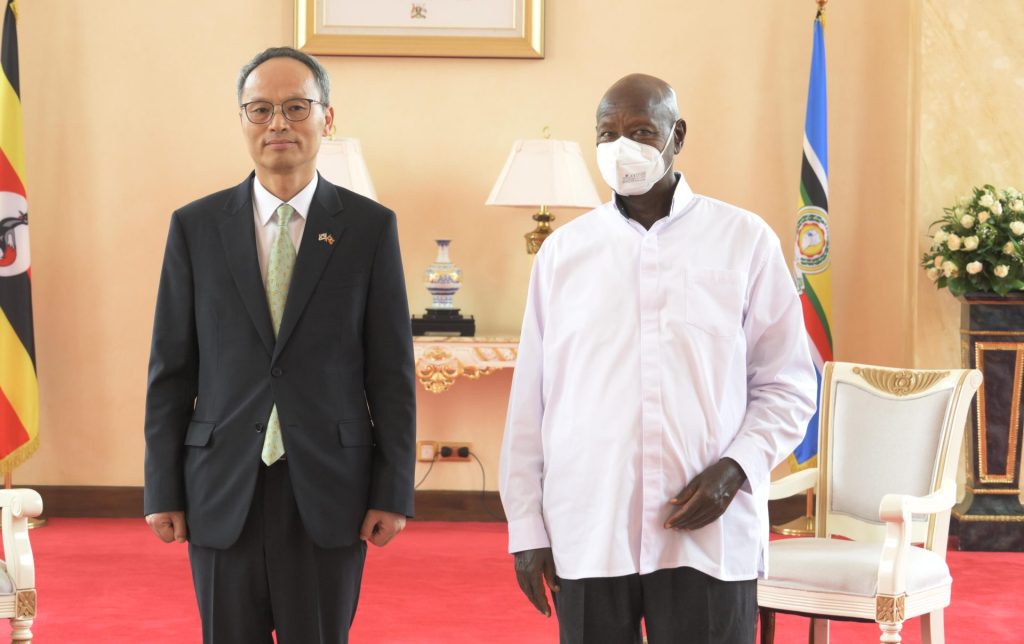
President Yoweri Museveni has called for the strengthening of the East African Common Market, warning that protectionist trade policies and high tariffs among regional partner states undermine economic integration and deny citizens the benefits of a larger shared market.
The President made the remarks at State House, Entebbe, while receiving Letters of Credence from four Heads of Mission-designate, officially accrediting them to represent their respective countries in Uganda.
The envoys were Kenya’s High Commissioner-designate, Amb. Ababu Namwamba; the Republic of Korea’s Ambassador-designate, Sangho Lee; Tanzania’s High Commissioner-designate, Maj. Gen. Marco Elisha Gaguti; and Namibia’s High Commissioner-designate, Gabriel Pandureni Sinimbo.
During his meeting with Kenya’s High Commissioner-designate, Amb. Namwamba, President Museveni emphasized the need for East African countries to deepen economic integration by eliminating barriers to trade.
He said imposing high taxes and restrictions on goods traded between Uganda and Kenya weakens the East African Common Market and ultimately hurts businesses and ordinary citizens across the region.
To illustrate his point, President Museveni cited Uganda’s decision to continue allowing Tanzanian rice into the local market despite repeated appeals from domestic rice farmers to ban the imports because of their lower prices.
The President reiterated that genuine regional integration requires member states to prioritize long-term economic transformation over short-term protectionist interests.
In response, Amb. Namwamba conveyed warm greetings from Kenyan President William Ruto and reaffirmed Kenya’s commitment to strengthening bilateral relations with Uganda.
He welcomed President Museveni’s vision for regional integration, describing the East African Community as the most viable pathway to sustainable economic growth and shared prosperity.
Meeting the Republic of Korea’s Ambassador-designate, Sangho Lee, President Museveni also reaffirmed Uganda’s commitment to strengthening bilateral relations with South Korea, emphasizing the importance of skills transfer and professional exchange to support Uganda’s socio-economic development.
By Newsroom
30th July 2026
END