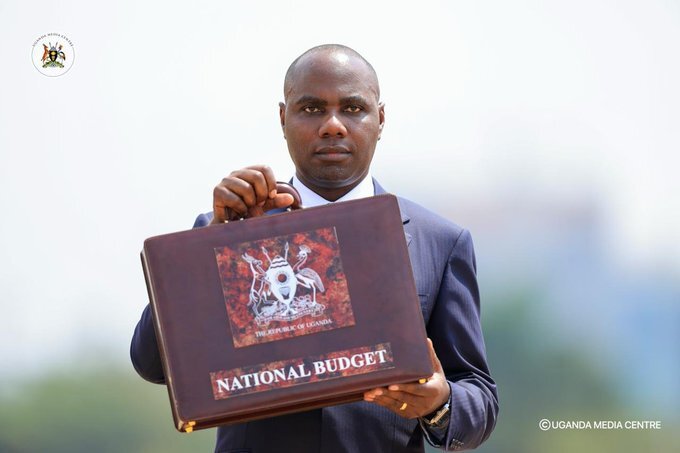
Minister of Finance, Planning and Economic Development, Henry Musasizi, has said Uganda’s economy remains strong and resilient, supported by rising exports, growing investor confidence, and low inflation as the country enters a new political term.
Presenting the 2026/27 national budget at Kololo Ceremonial Grounds, Musasizi noted that unlike previous election periods, which were often marked by high inflation, exchange rate volatility, and economic uncertainty, the country is maintaining macroeconomic stability while recording steady growth.
He said the government will continue prioritizing wealth creation, poverty reduction, job creation, and the realization of a $500 billion economy in the shortest time possible.
According to the minister, Uganda has maintained economic progress despite global economic shocks and has now attained lower-middle-income status. He added that the economy is projected to be worth UGX 250.4 trillion by the end of June 2026.
Musasizi emphasized that the country’s focus is no longer solely on expanding the size of the economy, but on ensuring that growth translates into meaningful benefits for citizens through job creation, higher household incomes, enterprise development, and shared prosperity.
He also revealed that the expected commencement of commercial oil production later this year is projected to accelerate economic growth to 10.2 percent, up from 6.4 percent in the current financial year. The oil sector, he said, is expected to create jobs, raise household incomes, expand business opportunities, and generate additional resources for investment in education, healthcare, infrastructure, security, and other public services.
The minister further highlighted growing investor confidence, reporting that foreign direct investment reached $3.2 billion in the 12 months ending March 2026. He noted that investors are increasingly backing Uganda’s small and medium-sized enterprises, with Kampala-based start-ups attracting approximately $30 million in investment in 2025, compared to $4 million the previous year.
Remittances from Ugandans living abroad also continued to rise, increasing from $1.9 billion to $2.8 billion, providing a significant source of foreign exchange earnings for the country.
Meanwhile, Parliament approved a record UGX 84.39 trillion (approximately $22.5 billion) budget for the 2026/27 financial year, up from UGX 72.37 trillion in 2025/26.
The budget will be financed primarily through domestic revenue of UGX 44.18 trillion, supplemented by domestic borrowing of UGX 11.97 trillion, external project support of UGX 11.27 trillion, domestic refinancing of UGX 13.97 trillion, petroleum revenues of UGX 1.44 trillion, budget support grants of UGX 1.22 trillion, and local government revenues of UGX 339 billion.
Of the total allocation, UGX 47.16 trillion has been earmarked for discretionary spending, while UGX 37.23 trillion will go towards statutory obligations, including debt servicing, salaries, pensions, and other mandatory expenditures.
The government says the budget is designed to sustain economic growth, strengthen service delivery, and position Uganda for accelerated development as it prepares to become an oil-producing economy.
By Francis Lubega
11th June 2026
End