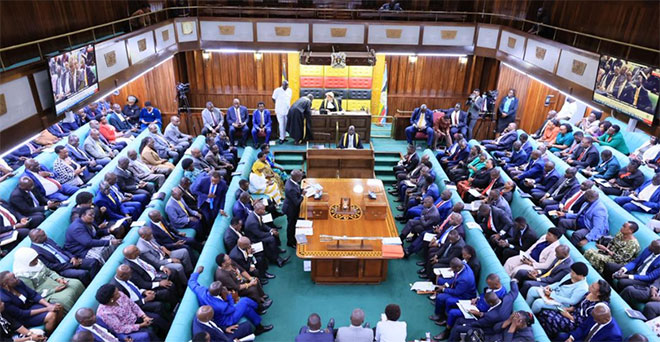
A total of 353 Members of the 11th Parliament passed one of the most controversial Bill in Uganda, the Protection of Sovereignty Bill, 2026.
345 were present and voted in person while 8 MPs participated virtually in a sitting presided over by the Speaker Annet Anita Among.
The bill passed around 9pm last evening under tense and heavily guarded sitting that revealed deep divisions among lawmakers over the extent of State control on foreign influence and national security matters.
The Bill was passed after Parliament adopted the report of the Joint Committee on Defence and Internal Affairs together with the Committee on Legal and Parliamentary Affairs, before lawmakers completed clause-by-clause consideration and approved the legislation at Third Reading.
The bill introduced on 14th April 2026 was passed on 5th May 2026. This means consultations were done in two weeks and passed in the third week although under normal procedures the law would be passed after 45 days after the first reading.
According to the joint committee report, views were collected from 224 stakeholders grouped under 60 categories, including the Bank of Uganda, the Uganda Law Society, political parties, religious institutions, universities, business associations, civil society organisations, diaspora representatives and the United Nations.
The committee acknowledged that many stakeholders supported the objective of protecting Uganda’s sovereignty, but raised concerns that parts of the Bill were over board, duplicated existing laws and granted excessive powers to the Minister.
Debate in the House became heated after the Leader of the Opposition, Joel Ssenyonyi, questioned the handling of the minority report during Committee Stage, arguing that dissenting members had been given limited time to present their views.
Kilak South MP Gilbert Olanya opposed the proposed penalties, warning that the law could negatively affect the economy, while Mukono Municipality MP Betty Nambooze criticised what she described as inadequate public participation during the processing of the Bill.
Despite the disagreements, Parliament proceeded to pass the legislation with several amendments, including narrowing the law to apply specifically to “agents of foreigners” and excluding Ugandans living abroad from the definition of foreigners.
The Bill also introduces safeguards to protect lawful foreign direct investment, diaspora remittances, trade finance, humanitarian assistance and development support following concerns raised by financial institutions and development partners.
Lawmakers further reduced several proposed penalties from 20 years imprisonment to a maximum of 10 years, with the offence of economic sabotage now targeting agents of foreigners who knowingly publish false information or engage in acts intended to damage Uganda’s economy.
The committee warned that vague provisions in the law could create a chilling effect on journalism, advocacy, research and business operations if not carefully enforced.
The Protection of Sovereignty Bill, 2026 now awaits presidential assent to become law.
By Alex Magala & Francis Lubega
06th May 2026
End