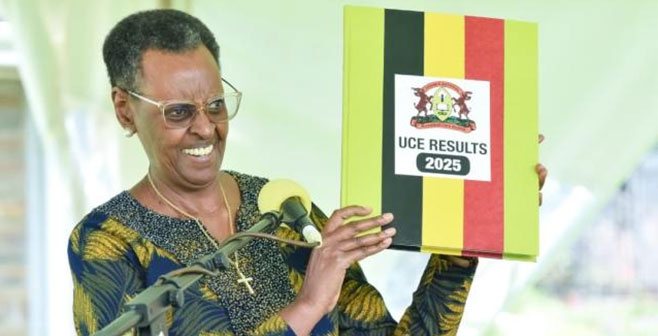
The Education Minister, Janet Kataha Museveni, has described the 2025 Uganda Certificate of Education (UCE) outcomes as encouraging, noting that a higher percentage of learners reached the defined competency levels compared to the 2024 cohort.
The minister attributed the improvement largely to evolving classroom practices, where teachers increasingly serve as facilitators of learning rather than the sole sources of knowledge.
She added that sustained implementation of the Competence-Based Curriculum, coupled with growing teacher familiarity with its requirements, will be critical in consolidating and enhancing learner performance in future examinations.
A total of 432,163 candidates from 3,975 examination centres registered for the 2025 UCE examinations, up from 359,417 in 2024, representing a 20.2% increase.
Of those registered, 204,292 (47.3%) were male, while 227,871 (52.7%) were female. Candidates under the Universal Secondary Education (USE) programme numbered 154,642 (35.8%), while 277,521 (64.2%) were non-USE beneficiaries.
In total, 429,949 candidates (99.5%) sat the examinations, compared to 357,120 in 2024, with only 2,214 (0.5%) absent. The absenteeism rate continued its downward trend, maintaining the improvement recorded the previous year.
Despite generally strong results across most Humanities and Arts subjects, History and Political Education emerged as the weakest-performing subject in 2025.
UNEB results indicate that 12,898 candidates, representing 3.0% of those who sat the subject, failed to attain the minimum level of competence and were awarded Grade E.
This grade signifies a below-basic ability to apply acquired knowledge and skills to real-life situations.
The Competence-Based Curriculum, progressively rolled out for lower secondary since 2020, emphasises higher-order skills such as critical thinking, problem-solving, and contextual application.
This reform aligns with national goals of producing graduates equipped to address 21st-century challenges rather than merely reproducing memorised facts.
UNEB observed that History teachers, in particular, appear not to have fully adapted to the new teaching and assessment approaches.
Similar instructional approaches across related disciplines may explain the consistent performance patterns observed in Social Studies and History, highlighting the need for teaching methods to be closely aligned with curriculum goals and assessment outcomes.
By Francis Jjunju
13th Feb 2026
END